← Back to Chemical Catalog
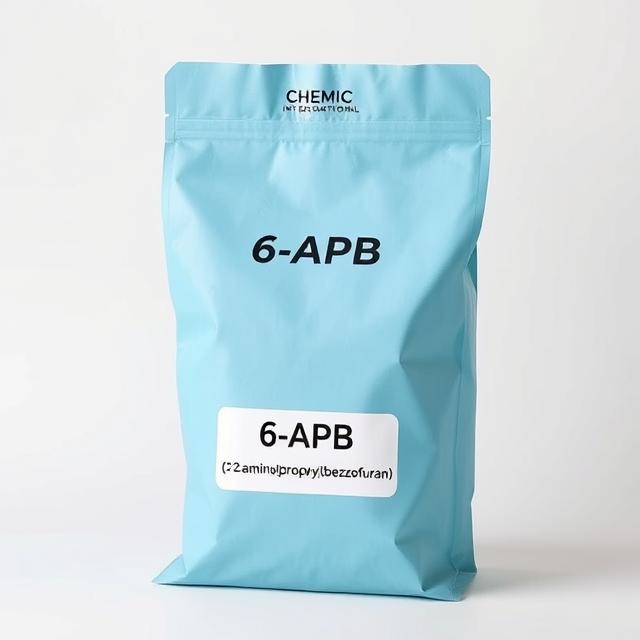
High-purity Buy 6-APb reagent General

Buy 6-APb

Purity Level ≥ 99.8% High-Purity Grade (Ready to Use)
Category Group General
Select Quantity (Weight):
Variation Price: €1625.00

Premium scientific reagent synthesized under strict laboratory conditions.

Scientific Characterization & Product Details

6-APB (6-(2-aminopropyl)benzofuran) is an empathogenic psychedelic from the benzofuran and phenethylamine family, which is often referred to as “benzofury” in the scene.Structurally, it corresponds to an open-chain variant of MDA in which the 3,4-methylenedioxy ring system has been exchanged for a benzofuran ring;it is also the unsaturated benzofuran version of 6-APDB.The material usually comes into circulation as a brownish, grainy powder.
rn
Although 6-APB never became a mass-produced product, it had brief guest appearances in the UK rave and club scenes between 2010 and 2013, before import and distribution there fell under the Novel Psychoactive Substances ban.In many other countries, the substance is not explicitly listed to this day, which is why it continues to circulate as a “premium compound” or “legal high”.
rn
rn
Common dosage forms and dosagernFreebase, hydrochloride (HCl) and succinate salt are commercially available.Potency scale (calculated):
rn
    rn
  • rn
    100 mg 6-APB HCl ≈ 83 mg freebase
  • rn
  • rn
    100 mg 6-APB succinate ≈ 60 mg freebase
  • rn
rnOral dosage (HCl salt, anecdotal)
rn
    rn
  • rn
    Threshold: 15 mg
  • rn
  • rn
    Light: 15-60 mg
  • rn
  • rn
    Common: 60-90mg
  • rn
  • rn
    Strong: 90-120 mg
  • rn
  • rn
    Heavy: >120 mg
  • rn
rn
Duration of action (oral)
rn
    rn
  • rn
    Start: 30-60 min (up to 2 hours on a full stomach)
  • rn
  • rn
    Rise: 1-2 h
  • rn
  • rn
    Plateau: 3-4 hours
  • rn
  • rn
    Descent: 2-3 hours
  • rn
  • rn
    Total: 7-10 hours, after-effects up to 48 hours possible
  • rn
rn
SubjectiveEffectrnEmpathogenic, slightly psychedelic and stimulating effects, comparable to a mixture of MDMA and MDA, but longer lasting and less “pushy”.
rn
rn
Side and risk profilernAnecdotal reports describe dry mucous membranes, jaw clenching, slight visual distortions and - in combination with synthetic cannabinoids - acute psychoses. Chronically, the strong 5-HT₂B agonism-based heart valve risk effect (see fenfluramine) is likely to dominate.
rn
rn
Pharmacology (rat synaptosomes)
rn
    rn
  • rn
    Monoamine release (EC₅₀):Serotonin 36 nM, norepinephrine 14 nM, dopamine 10 nM
  • rn
  • rn
    Reuptake inhibition (IC₅₀): serotonin 930 nM, norepinephrine 190 nM, dopamine 3,300 nM
  • rn
  • rn
    5-HT₂B receptor: Ki 3.7 nM, EC₅₀ 140 nM, Emax 70% (stronger than reference agonist BW-723C86)
  • rn
  • rn
    5-HT₂A: partial agonist, EC₅₀ 5,900nM, Emax 43%
  • rn
  • rn
    5-HT₂C: Ki 270 nM (partially agonistic)
  • rn
  • rn
    5-HT₁A: Ki 1 500 nM
  • rn
  • rnα₂C-adrenergic: Ki 45 nM
rnrn
The high 5-HT₂B selectivity (100-fold vs. 5-HT₂A/C) makes long-term cardiac consequences (heart valve fibrosis) likely.
rn
rn
PharmacokineticsrnSystemic data are missing, but users report slow onset (40-120 min), plateau up to 7 h, comedown 2 h and after-effects up to 24 h.
rn
rn
Metabolism (Rat)rnPhase-I: Furan hydroxylation → ring opening→ Reduction to the unsaturated aldehyde intermediate, then oxidation to the carboxylic acid or reduction to the alcohol with subsequent hydroxylation.Phase-II: Glucuronidation.Main metabolites: 3-carboxymethyl-4-hydroxyamphetamine and 4-carboxymethyl-3-hydroxyamphetamine.
rn
rn
Chemistry / AnalyticsrnColor reagent tests (Marquis, Mecke, Liebermann, Froehde) give uniform violet-to-black results.6-APB succinate is practically insoluble in chloroform and only slightly soluble in cold water;a DEA batch contained succinate and 6-APB in a ratio of 2:1.
rn
rn
Synthesis (Overview)rnAccording to Briner et al.3-bromophenol is reacted with bromoacetaldehyde diethyl acetal and NaH to form diethyl acetal, then cyclized with polyphosphoric acid (mixture of 4- and 6-bromobenzofuran), separated by column chromatography, oxidized to the propanequinone intermediate and reductively aminated.The resulting 6- or 4-APB freebases are isolated for commercial use as hydrochloride salts.

Customer Reviews

Donna Moore 4/10/2026
★★★★★
Everything perfect, will buy again. Buy 6-APb exceeded my expectations.
Heather Gutierrez 3/17/2026
★★★☆☆
The quality of Buy 6-APb is truly outstanding. Very satisfied.
Brenda Hill 2/13/2026
★★★★★
The quality of Buy 6-APb is truly outstanding. Very satisfied.
Raymond Ortiz 2/1/2026
★★★★☆
Very good value for money.
Joseph Ortiz 11/4/2025
★★★★★
Excellent service and a fantastic product.
Brian Garcia 7/22/2025
★★★★★
The quality of Buy 6-APb is truly outstanding. Very satisfied.
Margaret Miller 7/20/2025
★★★★★
I will definitely shop here again, top notch product.
Heather Evans 7/15/2025
★★★★☆
Everything perfect, will buy again. Buy 6-APb exceeded my expectations.
Emily Flores 7/4/2025
★★★☆☆
Great product, I highly recommend it!
Mary Hall 4/21/2025
★★★★☆
I will definitely shop here again, top notch product.
Kevin Young 9/13/2024
★★★★★
Good quality, fast delivery.
John Allen 3/18/2024
★★★★★
Buy 6-APb is exactly what I was looking for.

Frequently Asked Questions

What is the purity level of Buy 6-APb?

Our Buy 6-APb is supplied with a guaranteed purity level of at least 99.8%. Every batch undergoes rigorous validation to verify chemical integrity before dispatch. It is ready to use.

Do you sell to individuals?

Yes, we sell to both individuals and businesses. All our products are ready to use.

How are orders packaged and shipped?

Orders are shipped globally using discreet, vacuum-sealed packaging with full end-to-end tracking. Shipments are packed in neutral, heavy-duty parcels to ensure complete privacy and security.

How should Buy 6-APb be stored?

Store in a cool, dry place at room temperature (15–25 °C), shielded from direct sunlight and excess humidity. Sealed in its original vacuum packaging, chemical stability is preserved for at least 24 months.

External Scientific Registries & Databases

For further chemical specifications, molecular properties, hazard classifications, and reference spectra, consult the following international chemical registries: